
Tunica Municipal Release Records
Municipal Court is a case channel, not a detention facility. The Town's official page did not establish a municipal holding center or separate Town release roster. When a Town matter involves arrest and booking, the Tunica County Detention Center is the documented local custody system. The sheriff's release card can show the end of that booking, but it does not publish the release reason, authorizing court, destination, or final case result.
The Municipal Court file can preserve an order, plea, dismissal, sentence, payment history, or other disposition after the sheriff's short roster card expires. It may explain legal authority but not the exact moment jail processing ended. Accurate verification joins the court record with the county custody entry. Never treat the court address as proof that a person was held there.
| Recorded event | Next confirmation |
|---|---|
| Town police or Town case | Town of Tunica Municipal Court |
| Tunica County Sheriff matter | Tunica County Justice Court, unless filed as a felony |
| Mississippi Highway Patrol ticket | Tunica County Justice Court |
| Felony prosecution | Tunica County Circuit Court |
Confirm a Tunica Court Release
Start with the Town of Tunica Municipal Court page. It expressly distinguishes Town matters from tickets issued by the Tunica County Sheriff or Mississippi Highway Patrol, which go to Justice Court. This local routing prevents a common search failure. Similar street locations do not mean the offices keep the same record.
- Read the ticket, charging paper, or booking profile for the arresting agency and case number.
- Use Municipal Court for a Town matter, Justice Court for the Sheriff or Highway Patrol route, and Circuit Court for a felony.
- Ask for the docket, bond or release order, disposition, sentence, amended order, and later revocation or completion entry as applicable.
- Use the Tunica County jail release record for the actual custody timestamp.
- Compare identifiers and dates before joining the court order to the booking event.
The full Tunica County released inmate search connects the court route with recent county and state records.
Municipal Court Record Contact
The Town court page lists its clerk, telephone, office schedule, and court location. Court begins at the published time on the assigned date, but a case-specific setting should be confirmed with the clerk. Ask for a focused record by full name and case number. A docket or disposition can be more useful than ordering every page.
Town of Tunica Municipal Court1196 Edwards Avenue
Tunica, MS 38676
Phone: 662-363-2400
Fax: 662-373-1797
Office: Monday through Friday, 8:00 a.m. to 5:00 p.m.
The clerk identified in research was Christy Young, though personnel should be checked on the live page. For a Sheriff or Highway Patrol matter, contact Tunica County Justice Court at 5130 Old Mhoon Landing Road, telephone 662-363-2178. Its nCourt page is primarily a citation and payment service, not proof that every criminal disposition is online.
For felony matters, the Tunica County Circuit Clerk is at 1300 School Street, first floor, telephone 662-363-2842, with weekday office hours. Its order center advertises copies, record searches, and abstracts. Confirm the displayed unit or quantity before paying for an order.
Tunica Court Record Roles
The court record can explain release authority and the later outcome. A bond order may permit release. A dismissal or nolle prosequi can end a charge. A sentencing order defines the term and credits. A revocation order can return a supervised person to custody. None of these automatically supplies the physical door-out time, which belongs to the detention record.
The official Municipal Court image below confirms the Town case channel and its routing statement.
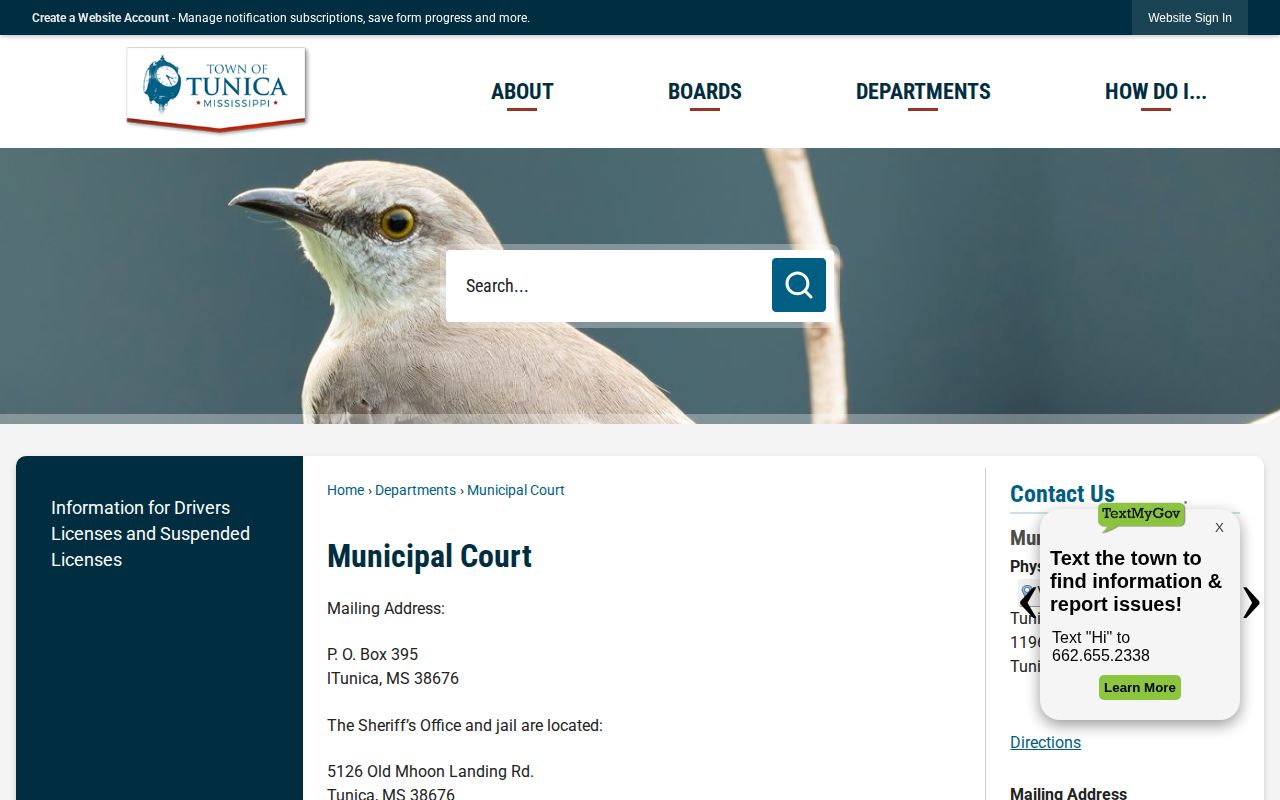
The source page should be read with the agency on the ticket so a county matter is not sent to the Town clerk.
Municipal, Justice, and Circuit files are not interchangeable. Older files, index spelling issues, restricted records, and cases outside an electronic system may require direct clerk contact. If no result appears, ask the clerk whether the file exists but is unavailable online or nonpublic.
Released Versus Case Disposition
Release answers whether a custodian relinquished the person. Disposition answers what happened to the case or charge. A person can be released while the case remains pending. A later dismissal does not necessarily mean the person left custody on the dismissal date. Likewise, a conviction can lead to probation, a local sentence, or transfer into MDOC custody.
Use a two-record method. First obtain the jail's positive release or transfer timestamp. Then obtain the court order or docket that states the legal action. If the records conflict, ask each custodian to identify the booking and case number used. Do not infer bond-out from a bond amount printed on a roster card.
- Release order
- Legal authority that can precede actual jail processing.
- Disposition
- The recorded outcome or current procedural status of a charge.
- Time served
- A sentence basis tied to credited custody time.
- Revocation
- A later action that can alter probation or release status.
Request Tunica Court Records
Give the clerk the full name, case number, approximate filing date, and exact document requested. If the case number is unknown, ask first for a search or abstract. Target the disposition, sentence, bond or release order, or revocation entry. A narrow request reduces cost and avoids receiving pages that do not answer the custody question.
Mississippi public-record law allows access subject to exemptions and redaction. Juvenile, sealed, expunged, victim-related, and other protected material may be restricted. A no-result may reflect access limits rather than no case. Ask what proof the clerk can lawfully supply.
Note: No municipal lockup was established in Tunica, so obtain custody time from the county detention record and case authority from the correct court.
Tunica Electronic Court Access
PAMEC and Mississippi Electronic Courts can provide subscriber access only for courts and cases implemented in the system. Research recorded a ten-dollar annual registration charge and a twenty-cent charge for each page of search results, including a one-page charge for a no-match search. Those terms do not prove that every Tunica Municipal, Justice, or Circuit matter is available. Confirm court participation and case coverage before paying.
Older paper records, spelling variations, restricted files, and clerk-only cases can all cause a blank electronic result. Courthouse viewing is generally available under MEC procedures, subject to restrictions and reproduction fees. Start with the correct court and case number. If the number is unknown, a clerk search or abstract can narrow the file before a larger copy order.
The Tunica Circuit Clerk order center separately advertises copies for one dollar, record searches for ten dollars, and abstracts for five dollars. Research did not establish whether every displayed figure applies per item, page, or request, so confirm quantity and certification needs with the clerk. Municipal Court and Justice Court use their own processes. Do not carry one office's price into another office's record request.
Tunica Restricted Case Records
Juvenile, sealed, expunged, victim-related, and other protected content may be unavailable or redacted. Expunction is a court process and does not prove that custody never occurred. A valid order may direct removal of specified state criminal-history material, while a jail, court, or independent source may have a different implementation duty. Read the order and ask each custodian what can lawfully be confirmed.
If a clerk denies access, ask whether the case exists but is nonpublic, which authority restricts it, and whether a public docket entry or certified statement can be supplied. Do not infer innocence, guilt, release date, or destruction from a blank screen. For a disputed door-out time, the sheriff release record remains the first custody source even when the case file is restricted.
A narrow request improves accuracy. Give the booking number when joining the case to a jail event, and compare full name, birth date, arresting agency, and date. Namesake errors are less likely when the custody record and court file share several identifiers.
The court file also lasts longer than the sheriff's public 48-hour card. Once the card expires, a disposition, bond order, or sentencing entry can still identify what the court authorized. Contact the detention center separately for the actual release or transfer timestamp. If the person entered MDOC custody, use the commitment order as the bridge and read the statewide location record. If the person remained on local probation, ask the sentencing court for the governing order rather than assuming MDOC's parole search covers it.
For an expunged or sealed matter, the affected person may need to show the order to each relevant custodian and ask how it was applied. A public clerk may be unable to disclose the file to a third party. That access limit does not permit a guess about the original release reason or later record status.