
MDOC Tunica Release Paths
No state prison was documented inside Tunica County. The statewide MDOC system is the correct route because a Tunica sentence can lead to custody anywhere in Mississippi. An MDOC inmate can also be temporarily housed in county-jail space. The public record's location and unit, not the county of conviction, show where the person is held. A field reading County of Conviction: TUNICA identifies the sentencing county only.
Three events must stay separate. A Tunica jail transfer ends the county booking but continues state custody. Release from an MDOC institution can place the person on parole or earned-release supervision while sentence authority continues. Final discharge ends the applicable state sentence or supervision. The MDOC search, Parolees Search, Community Corrections office, Board record, and discharge certificate each answer part of that sequence.
| Recorded event | Next confirmation |
|---|---|
| Entry into MDOC custody | Use inmate location, unit, entry date, and the commitment order. |
| Prison release to parole | Check the Parolees Search and Parole Board decision. |
| Release to ERS | Request MDOC time and supervision records; inmate status continues. |
| Final discharge | Obtain a discharge certificate or agency confirmation. |
Confirm an MDOC Release
The MDOC inmate search accepts first name, last name, or MDOC ID. The ID is the best key when known. A detail record can show a photograph, personal identifiers, entry and location data, sentence counts, offenses, sentence dates, conviction county, and Tentative Release Date. Research did not verify a durable public Released or Discharged label with an actual historical discharge date, so the interface should not be treated as a complete released-person archive.
- Search by MDOC ID, or use exact name spelling and compare biographical details.
- Read Location, Unit, and Location Change Date to determine present custody.
- Treat Tentative Release Date as a forecast, not an actual release entry.
- Check the separate Parolees Search when community parole is suspected.
- Request MDOC time, release-type, supervision, or discharge records when the web result cannot answer the question.
The Tunica County released-person search explains when the sheriff roster belongs before the statewide MDOC route.
MDOC Release Record Requests
MDOC Records handles questions about offender time, jail credit, eligibility, actual release type, and discharge. Specify the exact item. An inmate-search screenshot, offender timesheet, jail-credit computation, tentative release calculation, ERS or parole eligibility record, maximum discharge information, actual release type, and final discharge certificate are different records.
MDOC Records DepartmentP.O. Box 24388
Jackson, MS 39225
Phone: 601-933-2889
Email: MDOCRecordsDepartment@mdoc.state.ms.us
Provide full name, aliases, birth date, MDOC ID, conviction county, and a narrow date range. Ask for official time or status confirmation rather than demanding a prediction from a public date field. The MDOC main office is at 301 North Lamar Street, Jackson, Mississippi 39201, telephone 601-359-5600. The Tunica Probation & Parole Office handles local Community Corrections procedure after release.
For parole, the Board decision and minute entry may also matter. For a Tunica sentence, the Circuit Court commitment or sentencing order supplies the legal bridge from county custody to MDOC. These documents should be compared rather than blended into one undefined release record.
Read MDOC Record Fields
Location and Unit address present placement. OTHER CUSTODY, a county-jail unit, a satellite site, or an MDOC institution can all mean state custody continues in a different setting. Location Change Date marks a system movement. It does not establish release. Sentence fields and County of Conviction explain the legal record but do not identify the current physical site by themselves.
Tentative Release Date is MDOC's exact public label. The Family & Friends Guide describes it as an anticipated release after time-served credit and eligible earned-time adjustments. A maximum discharge date is the expected sentence endpoint without early-release allowances, though the public detail may not show it. The printable MDOC presentation warns that release types and dates may differ from the website.
The official MDOC search image below shows the correct statewide entry point for a Tunica conviction.
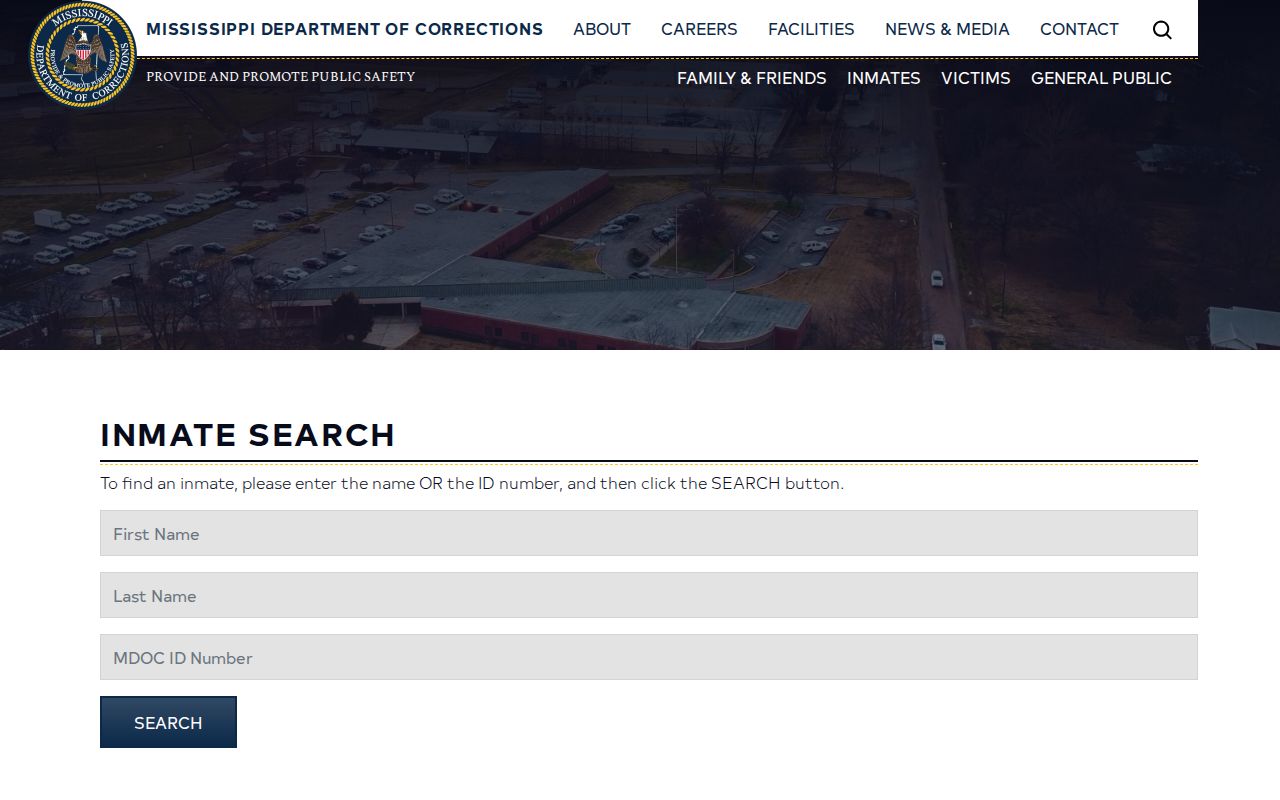
The search form is an entry to current offender data, while final release and discharge questions may require MDOC Records.
MDOC Release Status Terms
State correctional terms mark different points in a sentence. Parole is conditional community release authorized through the parole process. ERS is conditional release earned under MDOC rules while inmate status continues. Probation is imposed by a court and can exist without state imprisonment. Discharge generally marks completion of the applicable custody or supervision authority.
Eligibility does not equal approval. A parole-eligibility date is not a Board grant, and a future tentative date is not a door-out time. A positive Parolees Search result is strong evidence of community parole but does not prove the exact prison exit moment or eventual discharge date.
- Tentative release
- An anticipated date subject to lawful calculation changes.
- Parole
- Conditional release under state supervision.
- ERS
- Earned-release supervision with continuing inmate status.
- Discharge
- Official completion of the applicable sentence or supervision.
When MDOC Search Fails
First determine whether an MDOC sentence ever existed. Many Tunica County detainees leave on bond, dismissal, or a local sentence and never receive an MDOC ID. If state custody did exist, retry the known ID and name variants, then contact Records. A no-result cannot prove discharge, expunction, death, or mistaken identity because public retention of fully discharged detail records was not verified.
If the person left prison, check the distinct Parolees Search and contact Community Corrections. Ask the Parole Board for an individual decision where parole is involved. For final status, use the discharge certificate and relevant court order. VINE can provide event alerts, but it does not replace those official documents.
Note: MDOC covers state prisoners and state-managed supervision, not an ordinary Tunica County bond release or a federal sentence.
Tunica and MDOC Record Boundary
The county and state records meet at transfer. The Tunica County release log can record the time its jail relinquished custody. The Circuit Court commitment or sentencing order provides legal authority. The MDOC location record then shows where state custody continues. These three sources should align, but none can stand in for the others. A release card with no destination cannot prove MDOC placement, and an MDOC conviction field cannot prove the county's exact transfer time.
If MDOC temporarily houses an inmate in county space, that placement remains a state-custody question. Read Location, Unit, and Location Change Date. Do not assume that a county-jail unit converts the sentence into a local jail sentence. Similarly, a transfer to a different institution is a custody movement, not a release. The decisive community-release evidence comes from MDOC processing, Community Corrections or Board status, and the official time or discharge record.
Tunica County has no documented state prison within its borders. A conviction in Tunica can lead to confinement far from the county, and the correct institution can change. The statewide route avoids naming a distant prison as a local facility. The MDOC search identifies the actual placement at the time of the record.
MDOC Release Evidence Order
For actual state-prison release, an MDOC discharge certificate or official time record ranks above the public tentative-date field. A Board decision and Community Corrections record establish parole authority and supervision. A positive Parolees Search match is useful current evidence, while a VINE alert is a timely mirror that still requires confirmation. A family statement or social post can suggest where to search but should not become a release fact without agency documentation.
If a status is disputed, ask MDOC Records for the exact release type and date, final or current supervision status, and discharge document. If parole is involved, add the Board decision. If the public detail vanishes, do not equate absence with expunction or final discharge. The sentencing court and agency certificate preserve a stronger historical path than an unverified assumption about search retention.
Mississippi public-record procedures allow agencies to charge actual search, review, duplication, and mailing cost, subject to law and exemptions. Ask for electronic copies and an estimate before costs accrue. When material is withheld, request the specific exemption and any nonexempt portion that can be separated. Victim and other protected information can be removed without erasing all releasable time or status fields.
VINE adds notification, not final proof. Mississippi SAVIN covers MDOC state offenders and participating county jails, and its event list includes release and transfer. A notice can arrive quickly, yet it should be confirmed with MDOC because multiple system changes may create multiple alerts. The discharge certificate, Board action, supervision record, and court order remain the stronger sources for a complete state release history.