
Tunica Parole and Probation Differences
Parole and probation both allow a person to live outside a jail or prison while following legal conditions, but they begin in different ways. The Mississippi State Parole Board may grant parole after part of a prison sentence. A court orders probation, sometimes after a jail stay and sometimes with a suspended prison term. Neither status means the underlying case vanished. Both can end in discharge after all duties are complete, or in a violation process if a condition is breached.
Mississippi also uses earned-release supervision, called ERS, and post-release supervision. ERS is not final discharge. A person on ERS keeps inmate status under MDOC jurisdiction while living in the community. House arrest, intensive supervision, and interstate supervision have their own rules. The MDOC supervision overview supplies the controlling agency definitions.
| Status | Who authorizes it | Best verification |
|---|---|---|
| Parole | Mississippi State Parole Board | Parolees Search, Board decision, local MDOC office |
| Probation | Sentencing court | Court order and local MDOC Community Corrections |
| ERS | MDOC under state law | MDOC time record and Community Corrections |
| Final discharge | Supervising authority | Discharge certificate or final agency record |
- Discharge
- The formal end of custody or supervision, shown by an agency record.
- Absconder
- A person alleged to have stopped reporting or left supervision without approval. It is not the same as a final revocation.
- Revocation
- A legal or agency process that may return a supervised person to custody after a proven violation.
Verify Tunica Post-Release Supervision
The most useful public starting point is the separate MDOC Parolees Search. It accepts first name, last name, or MDOC ID. It is narrower than all forms of Community Corrections supervision. Research did not verify that every Tunica County probationer appears there, so a negative result cannot establish final discharge.
The official MDOC page shows the separate parolee lookup used for this first check.

The distinct tab helps prevent an inmate-search result from being mistaken for a complete supervision record.
- Search the exact name and, when known, the MDOC ID in the Parolees Search.
- Compare identifiers before treating a result as the same person.
- For probation, ERS, post-release supervision, or an unclear result, call the Tunica office and ask about the proper verification process.
- Use the sentencing court for probation orders and revocations. Use the Parole Board for parole decisions.
- Request the final discharge record when the question is whether all supervision ended.
A person can be outside prison yet still serve a sentence under conditions. Conversely, a county release may have followed bond or dismissal without any MDOC supervision. The full Tunica County released-inmate search path separates those populations before a supervision lookup begins.
If the Parolees Search returns no match, first determine whether the person ever received an MDOC sentence. Many Tunica County detainees leave after bond, dismissal, or a local sentence and never receive an MDOC ID. If state custody did exist, repeat the search with the known ID and name variants. Then contact the Tunica office or MDOC Records. The public search’s scope and retention do not support treating an empty result as proof of final discharge, expungement, or mistaken identity.
Probation requires a court-centered check. Town of Tunica matters, county Justice Court matters, and felony Circuit Court matters are not interchangeable. Obtain the sentencing or probation order from the court that entered it, then ask Community Corrections about the proper agency verification route. A revocation filing shows that action was requested or begun. It does not by itself show the final result, and the later docket entry may change or resolve the allegation.
Note: A blank public search is not proof that Tunica County supervision ended or that no probation order exists.
Tunica Supervision Office Verification
The local operational route is the Tunica Probation & Parole Office. It is an MDOC Community Corrections office, not a jail. A former state prisoner may report there after incarceration elsewhere in Mississippi. A probationer may also be supervised there under a Tunica court order.
The official local office listing confirms the Tunica supervision contact.
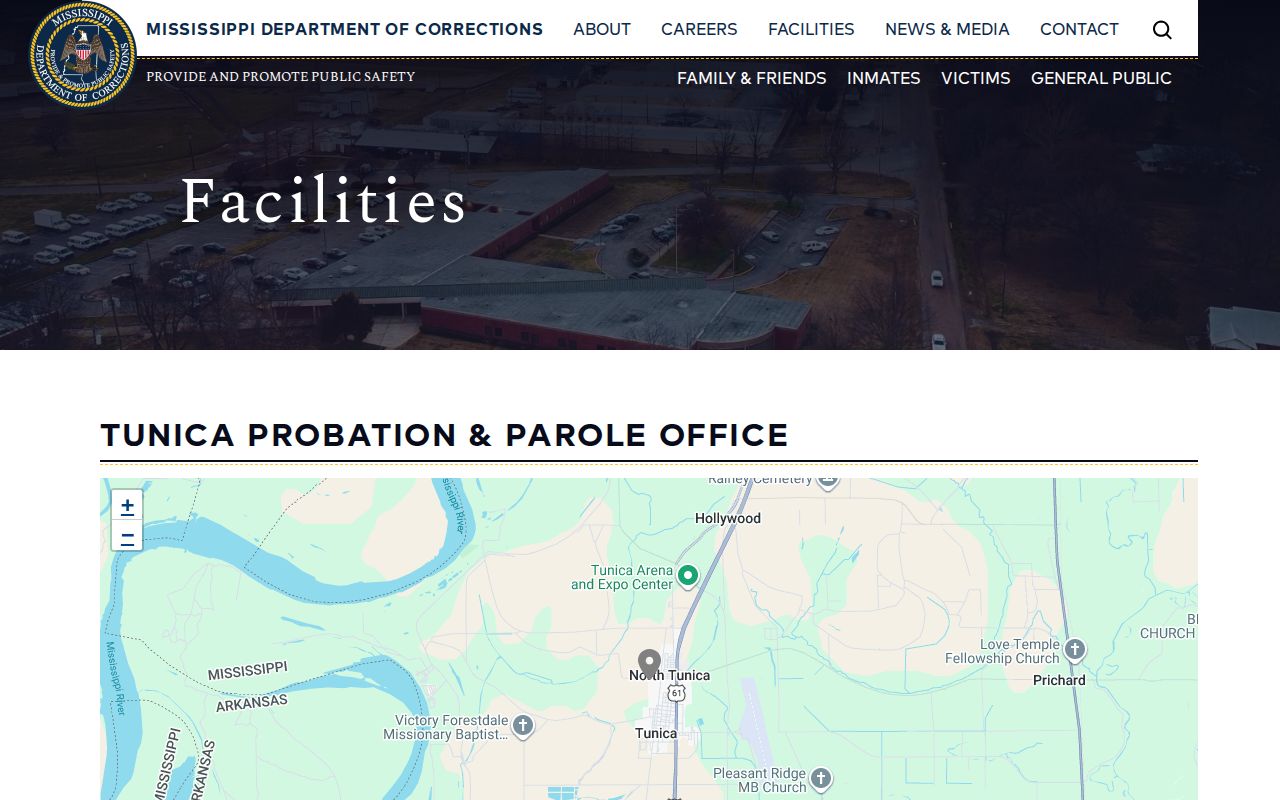
This office page is the local route for agency process even though it does not publish individual check-in details.
Tunica Probation & Parole Office5263 Old Mhoon Landing Road, Unit 2
Tunica, MS 38676
Mail: P.O. Box 1919
Phone: 662-363-5980
Fax: 662-363-5983
Public hours and check-in procedures were not posted. Call first. Staff may explain agency process but may limit a third party’s access to private reporting details. A person who is supervised should rely on the officer and written case instructions, not a general web result.
The office’s location near the Tunica County detention and court complex does not merge those agencies. The detention center answers whether it physically holds a person and can supply its release or transfer entry. Community Corrections handles MDOC supervision. The sentencing court controls a probation order, while the Parole Board controls a parole decision. Directing one narrow question to each office produces a clearer record than asking a single clerk to certify the whole custody history.
When calling about process, keep the question purpose-neutral and identify the record sought. Useful identifiers include the full name, date of birth, MDOC ID, sentencing court, and approximate release or order date. Do not request or publish an individual reporting schedule. Those instructions are case-specific and may not be public. The safer request asks whether the office is the correct custodian and how to obtain a releasable status or discharge record.
Tunica Supervision Warrants and Absconders
No verified statewide public MDOC absconder master search was found. The Tunica County Sheriff’s Most Wanted page contains county wanted notices, not a complete list of parole or probation absconders. A name there must not be labeled an MDOC absconder without confirmation from Community Corrections or the issuing authority.
Mississippi VINE can issue an abscond-supervision event or return-to-custody event when an agency supplies it. That alert is a lead. It is not the warrant, revocation order, or final finding. Conditions may include reporting, travel limits, treatment, payments, or other case-specific duties, but the actual order controls. A suspected violation may lead to an allegation, hearing, or warrant. Only the proper court or Board record establishes the outcome.
VINE also distinguishes events that are easy to collapse in casual use. A transfer, temporary movement, release from custody, escape, abscond-supervision event, and return to custody are separate notices. Multiple agency updates can create multiple alerts. Confirm the event with Mississippi SAVIN or the originating office before stating that Tunica County supervision began, ended, or was revoked. Tunica County jail participation was not independently confirmed in an official county list, which makes direct facility confirmation especially important.
Note: A warrant allegation, an absconder event, and a final revocation are distinct Tunica County supervision records.
How Tunica Supervision Records End
Supervision ends through a formal act, not merely because a person stops appearing in a search. For parole, obtain the Board or MDOC record that states the current status and final discharge. For probation, the sentencing court file may hold the completion, modification, or revocation entry. ERS ends differently because the person remains under MDOC jurisdiction while on that form of release.
The public MDOC inmate search was not verified as a durable history of fully discharged people. A no-result may reflect scope or retention rather than a clean end date. Ask MDOC Records for the discharge certificate or official status record. Give the full name, MDOC ID, birth date, and the precise record sought. This narrows the search and reduces namesake errors.
For parole, pair the discharge question with any Board action and Community Corrections record. For probation, ask the sentencing clerk for the completion or termination entry and any later order. If only part of a public record can be disclosed, Mississippi public-record procedures allow exempt details to be redacted while nonexempt material is produced. A narrow request for status, date, and authorizing document is more useful than a broad request for every supervision file.
Tunica Parole Decision Records
The Mississippi State Parole Board handles individual parole status and decision-record questions. Hearings are scheduled on a monthly cycle, but no public inmate-by-inmate calendar or general results database was verified. Eligibility means the Board may consider release. It does not promise a grant.
For a focused request, provide the person’s name, MDOC ID, and approximate hearing or decision month. Administrative rules state that decisions go to the offender and to a victim or family member in writing, while disclosure to others is decided case by case. The Board also keeps minute-book copies of official actions and reasons. Historical minutes held by the state archives do not replace a current decision request.
Board contact is 239 North Lamar Street, Suite 501, Jackson, MS 39201, phone 601-576-3520. The Board record explains parole action; the MDOC time record explains sentence computation.
A parole hearing record and a supervision record serve different purposes. The first records how the Board acted on eligibility. The second shows whether Community Corrections still supervises the person after release. If dates appear to conflict, request both records and the MDOC time computation. Do not treat a hearing month as a prison exit date, or a parole grant as the end of all sentence duties.
The Board’s administrative rules also limit what can be disclosed when material could identify a confidential source, endanger someone, or harm a person’s return to society. A requester should ask for the releasable decision or minute entry rather than promise that a stated reason guarantees access. If the request is limited, record the redaction or access decision accurately. Historical Board minutes held by the Mississippi Department of Archives and History cover older actions and are not a substitute for current Tunica County supervision confirmation.
Tunica Post-Release Reentry Support
MDOC’s reentry resource guide identifies a regional Resource Assistance Program covering Tunica along with Bolivar, Coahoma, and Quitman counties. It can be a route for documents, appointments, and program navigation after release. The guide dates from November 2022, so contact details should be checked before use.
Reentry help does not verify legal status. The person’s officer, court order, Board decision, and discharge record remain the sources for supervision terms. Treat the guide as navigation, then confirm the current provider and service area.