
Tunica Projected and Actual Release
MDOC uses the exact label Tentative Release Date. Its guide defines that date as the expected incarceration release after earned time and time-served credit are applied. “Tentative” matters. It can move as credits, orders, sentence terms, and holds change. A maximum discharge date is a different concept: the expected sentence endpoint without an early-release allowance.
The official MDOC detail illustrates the Tentative Release Date field within a state offender record.
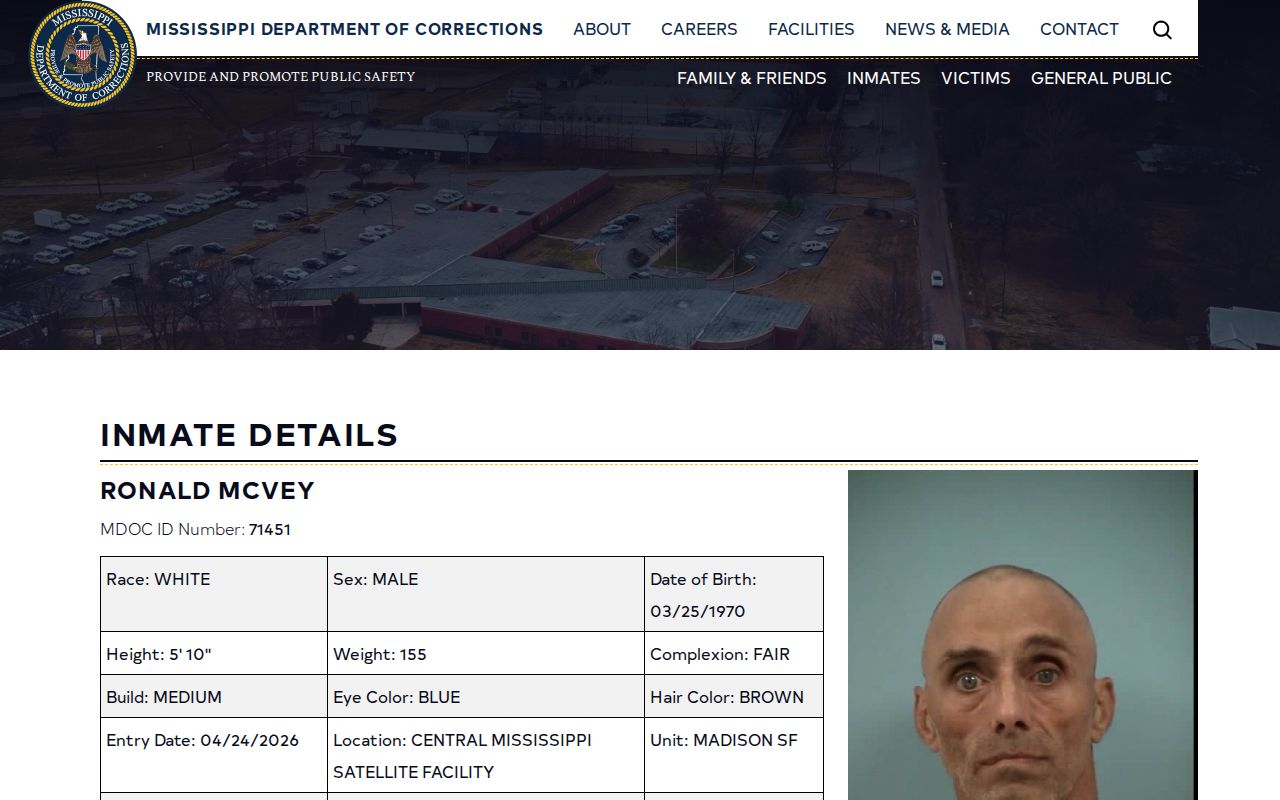
The image places the estimate beside sentence and location data, which must be read together before a release date is interpreted.
A pretrial detainee has not begun serving a final sentence for that charge and often has no computed release date. Bond, dismissal, a plea, sentencing, or a hold may control the next event. A court order can authorize release before jail processing ends, so the order and the jail’s door-out time answer different questions. A transfer also ends Tunica County jail custody without putting the person in the community.
Find Tunica Projected Release Dates
Start with jurisdiction. The MDOC inmate search applies to state prisoners and MDOC-managed custody. It does not compute a date for a person who left Tunica County Detention Center on bond or served only a local term. Federal sentences use federal records. A county-jail term depends on the Tunica sentencing order, credited time, and the jail’s own records.
- Determine whether the person is pretrial, serving a Tunica local sentence, or serving an MDOC sentence.
- For MDOC custody, search by MDOC ID when possible, then verify the name and county of conviction.
- Read Location, Unit, Location Change Date, sentence fields, and the exact Tentative Release Date label together.
- For a county term, request the sentencing order and jail-credit record from the proper court and jail.
- Ask MDOC Records or Tunica jail staff to confirm the computation and any hold before relying on a date.
The Tunica County released-inmate lookup explains how to trace an actual county release after the event. A future MDOC field cannot establish why Tunica relinquished an earlier booking.
The MDOC detail supplies more than one date and location clue. It can show entry date, current location or unit, location-change date, sentence count, total sentence length, each offense, conviction county, and sentence date. Read those fields before the tentative date. “County of Conviction: TUNICA” identifies the source of a sentence, not a prison in Tunica County. A county-jail unit, other-custody label, or recent location change may still reflect active state custody.
If the public search returns no record, do not assume release. First confirm that an MDOC sentence existed. Search by ID and name variants, then contact Records with the sentencing information. The research did not establish how long fully discharged details remain public or verify a universal actual-release label. The court commitment, MDOC time record, and discharge certificate carry more weight than an empty search screen.
Tunica MDOC Earned-Time Computation
Mississippi Code §47-5-138 permits an allowance of four and one-half days for each thirty days served for covered sentences imposed after June 30, 1995, when MDOC finds that conduct and performance rules were met. The allowance cannot exceed fifteen percent of the sentence. That cap produces the common “serve 85 percent” shorthand, but it is not a safe universal calculator.
Offense and sentence dates, exclusions, pretrial jail credit, forfeited credits, concurrent or consecutive terms, prior sentences, detainers, amended court orders, and agency verification can change the result. Under the statute, early release through this section is earned-release supervision. The person retains inmate status under MDOC jurisdiction. ERS is therefore not the same as maximum discharge.
Eligible pre-sentence jail credit is applied to establish the sentence begin date under MDOC’s handbook. Time spent in a county jail after an MDOC sentence may be handled differently. The offender timesheet, case manager, and MDOC Records are the sound sources for a particular computation. A simple fifteen-percent subtraction would ignore the facts that control the sentence.
Sentence structure also matters. Concurrent terms run together to the extent the orders allow, while consecutive terms run one after another. Prior sentences, a later amended order, and offense-specific exclusions can change which clock controls. Certain day-for-day crimes may be shortened only by valid pretrial credit. Because the public detail may summarize several counts, the total sentence length should be reconciled with the judgment and timesheet before any estimate is repeated.
The statute’s fifteen-percent ceiling describes the maximum earned-time allowance under that provision, not a promise that every eligible person receives the full amount. MDOC must find compliance with conduct and performance requirements, and credits may be withheld or forfeited. Older sentences and statutory exceptions require separate review. The correct question for Records is how the agency computed this person’s term, not whether a general percentage can be subtracted.
Note: Tunica County publishes no local jail good-time policy or calculator, so MDOC’s earned-time rule must not be applied to a local term.
Why Tunica Release Dates Change
A tentative date is recalculated when facts in the sentence record change. Some changes move the estimate earlier. Others delay release or change the event from a community release to a transfer. The public field alone may not show the reason.
| Factor | Possible effect | Confirm with |
|---|---|---|
| Jail credit verified | Changes sentence start or credited time | MDOC timesheet and court record |
| Credits earned or forfeited | Moves the tentative date within legal limits | MDOC Records |
| Corrected court order | Changes term, count, or sentence relationship | Sentencing court |
| Detainer or hold | May cause transfer instead of community release | Holding and receiving agencies |
| Parole or ERS action | Changes custody form, not necessarily final discharge | Board and Community Corrections |
| Release paperwork | Can delay processing after eligibility | Case manager and MDOC |
MDOC states that release processing can take thirty to forty-five days and that a discharge certificate must be received. Its guide also warns that ERS and parole eligibility dates are not guaranteed release dates. Eligibility opens a legal path; it does not complete the agency process.
Release paperwork is not just a clerical footnote. Staff must reconcile the sentence, valid jail credit, earned-time status, court changes, and any other agency hold before the custody event can be finalized. The public estimate may remain unchanged while that review is under way. For that reason, a family plan, pickup plan, or court filing should use direct agency confirmation rather than a countdown built from the web field.
A detainer is a request or hold from another authority. It can change the destination without changing the fact that MDOC’s custody ended. The precise statement may be “no longer in MDOC custody” rather than “released to the community.” Ask for the receiving agency when a hold exists. If federal or immigration custody follows, use that system’s locator or records because the MDOC date cannot establish the later agency’s status.
Confirm Tunica State Release Dates
The public MDOC detail displays a photo, MDOC ID, location, offenses, sentence data, and Tentative Release Date. Research did not verify a durable public Released or Discharged label with an actual date for every former prisoner. If a person drops from results, request a discharge certificate, time computation, actual release type and date, or current supervision status from MDOC Records.
MDOC RecordsP.O. Box 24388
Jackson, MS 39225
601-933-2889
MDOCRecordsDepartment@mdoc.state.ms.us
Provide full name, birth date, MDOC ID, and a precise request. The sheriff cannot certify a later state computation merely because the person once had a Tunica booking. For a future event alert, the VINE Inmate Check may help if the relevant agency participates, but an alert still needs agency confirmation.
A useful request distinguishes the tentative release date from maximum discharge, parole eligibility, ERS eligibility, actual release type and date, and final supervision discharge. Each answers a different question. Request the offender timesheet and jail-credit computation when the concern is how the estimate was reached. Request the discharge certificate when the concern is whether state custody or supervision has formally ended.
Tunica Parole Eligibility Clock
Parole eligibility is separate from the tentative release computation. Mississippi Code §47-7-3 states that earned time or another administrative reduction does not reduce the service required for parole eligibility. Current general categories use different fractions and maximum periods based on offense class, dates, and exclusions. The underlying judgment must be read before applying any category.
Eligibility means consideration by the Mississippi State Parole Board. It is not a grant, door-out date, or discharge. A Board decision can place a person on parole under conditions, while a denial leaves the lawful sentence computation in place. Confirm the individual result with the Board, the case manager, and MDOC.
The Board operates on a monthly hearing cycle, but no verified public person-by-person calendar or general decisions database was found. For an individual, give the Board the name, MDOC ID, and approximate eligibility or decision month. A focused decision or minute request can verify action that a future-date field cannot show. Even after a grant, release processing and any other hold must still be resolved.
Tunica County Jail Release Dates
A Tunica County jail sentence that never becomes MDOC custody has no MDOC Tentative Release Date. Use the sentencing order, commitment, and credited-time record. Call Tunica County Detention Center at 662-363-1411 for custody status and the recorded release or transfer time. Routine record requests are best made during administrative hours, Monday through Friday from 8:00 a.m. to 5:00 p.m.
No official local good-time rule, weekend-release practice, fixed release-day schedule, or calculator was found. Those gaps must remain visible. Ask the court and jail for the actual computation instead of importing state-prison rules. If another agency has a detainer, the end of Tunica custody may be a transfer rather than return to the community.
Request Tunica Release Computations
An exact state-sentence question should name the record needed. An inmate-search screenshot, offender timesheet, jail-credit calculation, tentative release date, ERS eligibility date, parole eligibility date, maximum discharge date, actual release type, and final discharge certificate are not interchangeable. Ask MDOC Records for the narrow item that answers the question. Include the person’s MDOC ID and the conviction county when known.
For a local Tunica term, request the sentencing order, any amended order, jail-credit entry, commitment, and the jail’s release or transfer entry. The sentencing court explains the lawful term. The detention center records the actual end of its physical custody. If MDOC assumed custody, the commitment and transfer record bridge the county event to the later state computation.
A written response is stronger than a phone estimate when the date affects a court process or family coordination. Ask whether a listed date is tentative, an eligibility date, a planned processing date, or an actual release. That single distinction prevents most errors.