
Federal Release Paths from Tunica
The Federal Bureau of Prisons is a nationwide prison system, not a Tunica County jail. No federal prison was found within the county. A person connected with Tunica may enter federal custody after a federal court order and U.S. Marshals processing, then be placed at a BOP institution elsewhere. A Tunica County jail card may record transfer out of local custody without proving community release.
Later, BOP can record the end of its custody. A past release date with no institution or a RELEASED location means the person is no longer in BOP custody. That statement is narrower than saying the person is free. Immigration detention, a state hold, a new case, or federal supervised release may still apply. The federal docket supplies the judgment, detention or release order, and supervision terms.
| Recorded event | Next confirmation |
|---|---|
| Past date, no institution | BOP says Bureau custody ended on that date. |
| RELEASED | The person is no longer in BOP custody. |
| IN TRANSIT | Custody movement continues; this is not release. |
| UNKNOWN date | The confinement term is not determined in the public field. |
Confirm a Federal Release
Open the official BOP Inmate Locator. It generally covers federal prisoners from 1982 forward. Search with a BOP, FBI, DCDC, or INS number when one is known. Exact-name searching is available, but identity checks matter when names repeat. Compare age, identifier, and other returned details before reading the status.
- Search by federal identifier first, or use exact name and compare identity fields.
- Read the Release Date and Location together.
- Do not interpret IN TRANSIT, UNKNOWN, or a future date as completed release.
- Open the federal docket for the judgment, release order, and supervision term.
- Check ICE, state, or local custody when another hold or transfer is documented.
Use the Tunica County release search first when the event began as a local booking rather than a federal sentence.
Federal Release Record Sources
BOP's public locator gives a system-specific date and location. Its federal inmate records explanation defines the public fields and warns against misreading movement as release. The federal court docket is the second key source. It can contain a judgment, commitment, detention order, release order, and supervised-release terms that the locator does not explain.
Federal Bureau of PrisonsNationwide federal prison system
No BOP institution documented in Tunica County
Public route: BOP Inmate Locator
Legal route: relevant federal court docket
Older pre-1982 federal records may require the National Archives. A person held pretrial by the U.S. Marshals may never become a sentenced BOP inmate, so a BOP no-result is not enough. Use the federal clerk and relevant Marshals district office for allowed confirmation. Ask for a specific case or custody record rather than a broad narrative.
The official field-definition image below shows why date and location must be read together.
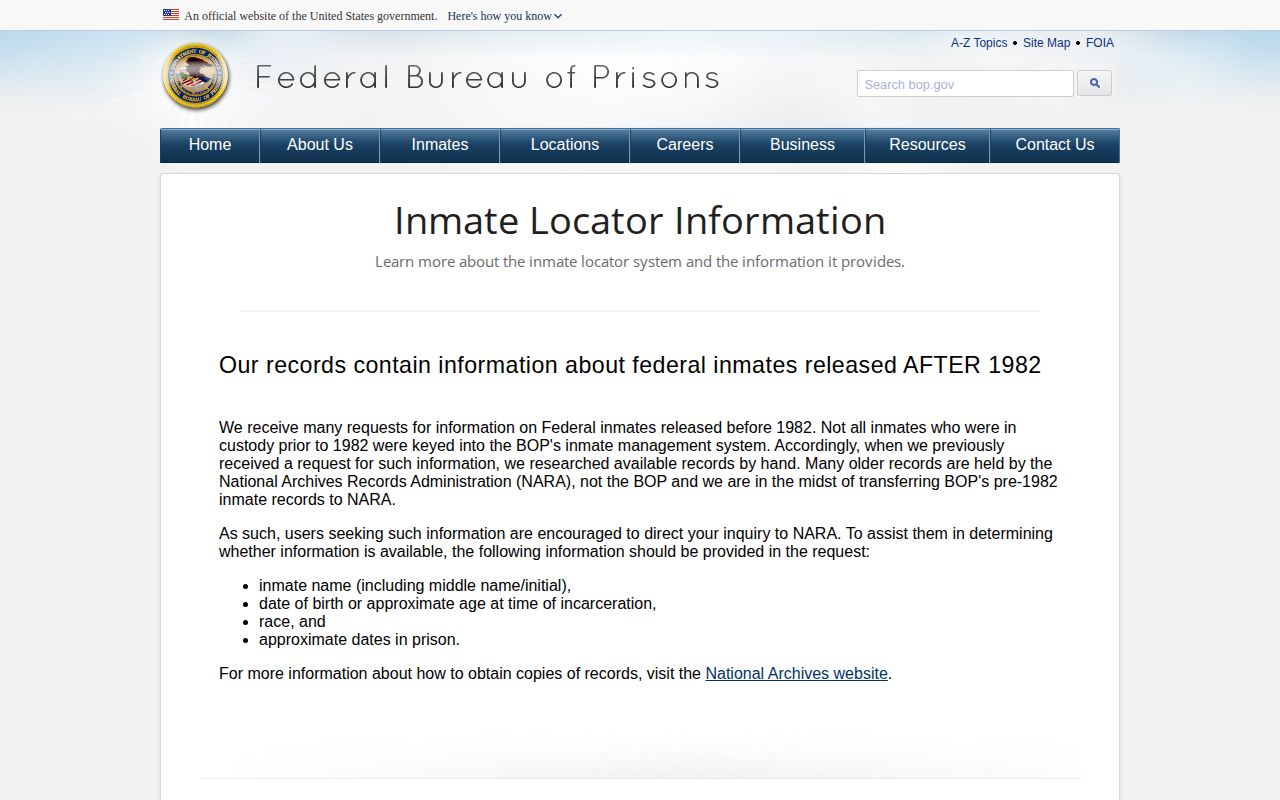
Its terms support the precise conclusion that BOP custody ended, while other restraints require separate checks.
Federal Custody Status Meanings
A future BOP date is projected. UNKNOWN means the term cannot be determined from the public record. IN TRANSIT can reflect transport or temporary Marshals removal and means custody continues. A past date with no facility or a RELEASED location supports only that the person left BOP custody. These exact distinctions prevent a movement entry from becoming a false community-release claim.
Federal supervised release is imposed by the court and continues after prison. It is not BOP prison custody, but it remains a legal condition. Review the judgment and later docket entries for its length, modifications, violations, or termination. A BOP result alone does not report the full court history.
- BOP custody
- Custody within the federal prison system.
- USMS custody
- Federal pretrial, transport, or court-related prisoner management.
- Supervised release
- Court-ordered federal supervision after imprisonment.
- Detainer
- A request or notice that another authority may assume custody.
Tunica to Federal Transfer
If the Tunica jail reports transfer to a federal agency, ask for the destination and transfer authority. The county timestamp ends Tunica custody. It does not prove admission to BOP or return to the community. USMS can hold and transport a federal pretrial prisoner before sentencing, and there is no general public historical Marshals release locator.
Follow the federal docket first. If a sentence led to BOP custody, then use the BOP identifier and public result. If immigration detention followed, switch to the ICE current-custody route. Preserve the sequence of agencies rather than calling the first local release time the final outcome.
- Release
- The named custodian relinquished custody, which can include transfer.
- Discharge
- The agency generally records completion of a sentence or supervision term.
- Transfer
- Custody continues with another agency or facility.
- Time served
- A legal basis tied to credited custody time, not merely days elapsed.
When Federal Search Fails
Retry with an identifier and confirm the 1982 coverage boundary. A locally arrested person may have been in Marshals custody without entering BOP as a sentenced prisoner. Names can also vary. Use the federal clerk's docket, relevant Marshals office, ICE route, or National Archives according to the documented custody path.
A BOP no-result says nothing about MDOC or Tunica County custody. Likewise, an MDOC no-result does not resolve federal status. Positive dated agency records outrank assumptions based on an empty search.
Note: No BOP prison is documented in Tunica County; this system page follows federal cases wherever the actual institution is located.
Federal Release Court Records
The federal docket supplies legal context that the BOP locator cannot. A detention order addresses pretrial custody. A judgment states the sentence and supervised-release term. A release order or later modification can explain why custody changed. The public locator focuses on BOP status, so it may not show the court's full sequence or a later non-BOP restraint.
Use the exact case number, district, and defendant identifiers. A federal arrest connected to Tunica County may be filed in a federal district court rather than a county court. PACER or the federal clerk route is the correct record channel. When an order and BOP date differ, remember that authorization, transport, and processing can occur at different times. Ask which record documents actual Bureau release and which documents legal authority.
If federal supervised release follows prison, the person is outside BOP custody but remains under court-ordered conditions. The judgment and probation-office docket events address that term. BOP's RELEASED location does not mean supervised release ended. A later revocation can also return the person to custody, which requires a new dated record rather than reinterpretation of the earlier release.
Federal Release Evidence Order
For a federal release, the strongest public pair is a BOP released result and the federal docket. The BOP field guide defines the date and location. The judgment or release order explains the legal case. A Tunica sheriff card matters only if the person also had a local booking. MDOC is not a substitute for BOP, and a federal result is not a substitute for an ICE check.
When a person moves through USMS, BOP, and ICE, build a timeline. Record the last confirmed custodian, transfer date, next agency, and each system's status. A county release can precede federal transport. A BOP release can precede ICE detention. Only the last verified source can answer present custody. This disciplined sequence prevents the word released from being stretched beyond the agency that used it.
A search failure has limited meaning. Retry identifiers, name forms, and the proper date coverage. Use the National Archives for older federal prison records and the federal clerk for a person who never reached sentenced BOP custody. Ask for a precise record rather than assuming that no locator match means no federal case.
Federal and local records can overlap without duplicating each other. If Tunica County held the person under a federal arrangement, the county log can document that facility's custody period while the federal docket explains the federal authority. The BOP record begins only when the person enters the Bureau system. Preserve all three agency names and dates. This avoids treating a local booking number as a BOP identifier or a Marshals movement as a prison release.
If ICE takes custody after BOP, switch to the current immigration locator and direct ICE confirmation. A BOP past release date remains accurate as to the Bureau even while another custodian holds the person. The final statement should name the agency: released from BOP custody, transferred from Tunica custody, or presently located in ICE custody. Agency-specific language is more accurate than an unsupported claim that all custody ended.